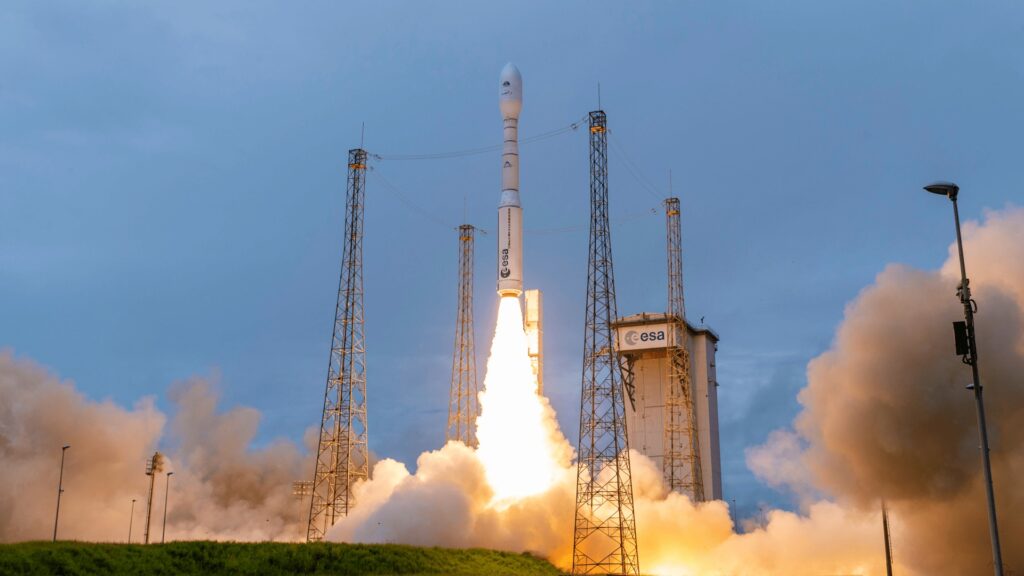
On 20 December 2022, Europe’s Vega C rocket — a new medium-lift launch vehicle — suffered a dramatic failure shortly after liftoff, destroying both of its payload satellites. The mission, designated Flight VV22, was one of the most anticipated European space launches of the year but became a somber reminder of the inherent risks in rocketry.
https://x.com/liveoflings/status/1986658559459791191
| Entity | What it is |
|---|---|
| Vega C | A four-stage rocket developed by the European Space Agency (ESA) and operated commercially by Arianespace. Designed to carry ~5,070 lb (~2,300 kg) payloads to a sun-synchronous orbit — ~50% more than the original Vega. |
| Pléiades Neo | A series of high-resolution Earth-observation satellites built by Airbus Defence and Space. The lost satellites were Pléiades Neo 5 & 6, intended to complete a four-satellite constellation. |
| Zefiro 40 | Vega C’s second stage solid rocket motor. This stage malfunctioned during Flight VV22, triggering the mission’s failure. |
📊 Mission Snapshot
| Parameter | Specification |
|---|---|
| Launch Date & Time | 20 Dec 2022, 22:47 Local (Kourou, French Guiana) |
| Launch Site | Guiana Space Centre (ELA-1) |
| Rocket | Vega C (Flight VV22) |
| Payload | Pléiades Neo 5 & 6 (~1,977 kg total) |
| Failure Phase | ~2 min 27 sec into flight during Zefiro 40 burn |
| Outcome | Mission lost; debris hit Atlantic Ocean |
📉 What Happened — A Simple Timeline
- 🚀 T = 00:00 — Liftoff; first stage (P120C) performs nominally.
- 🔥 T ≈ 2:27 — Second stage (Zefiro 40) ignites but experiences a loss of chamber pressure.
- 📉 T ≈ 3:28 — Trajectory deviates; rocket is destroyed by range safety.
- 🌊 T ≈ 10 min — Debris falls into the Atlantic Ocean.
📊 Quick Stats
- ✈️ Payload mass: ~1,977 kg (Pléiades Neo 5 & 6)
- 📏 Rocket height: ~35 m (~115 ft)
- ♻️ Pléiades Neo mission life (planned): ≥10 years each
- 🇪🇺 Insurance value of lost satellites: ~€222M (~$240M)
🌟 Fun Facts
- 🛰️ Orbit target: Sun-synchronous orbit (~620 km altitude), ideal for Earth imaging.
- 📸 Pléiades Neo satellites could image the Earth at ~30 cm (11.8 in) resolution — enough to see vehicles.
- ⚙️ Historic context: It was only the second flight of Vega C — maiden flight was successful in July 2022.
❓ Frequently Asked Questions
Q: Why did the Vega C fail?
A: A pressure loss in the Zefiro 40 second stage motor caused trajectory deviation, leading range safety officials to destroy the vehicle.
Q: Were people hurt?
A: No — the launch site safety protocols prevented any injury or ground damage.-
Q: Was this due to a design flaw?
A: An enquiry found the cause was likely material/erosion issues in the nozzle throat insert of the second stage.
Q: What happens next for Vega C?
A: ESA and Arianespace formed an independent commission to analyze the failure and recommend corrective actions for future flights.
Q: Does this impact other European rockets?
A: Preliminary findings indicate no direct impact on Ariane 6 or other launchers.-
In rocketry, even the smallest composite material can determine the fate of a mission. The Vega C failure of 20 December 2022 was a stark illustration of precision engineering — and precision risk — at the edge of space. 🚀