On December 21, 1946, a powerful Nankaidō earthquake struck southern Japan along the Nankai Trough, triggering a devastating tsunami. The disaster killed at least 1,000 people and destroyed approximately 36,000 homes, leaving coastal communities in ruins. This event became a cornerstone case for Japan’s modern tsunami preparedness.
Key Facts Table
| Attribute | Detail |
|---|---|
| Date | December 21, 1946 |
| Magnitude | ~8.1 |
| Epicenter | Nankai Trough, Japan |
| Secondary Hazard | Tsunami |
| Fatalities | ≥ 1,000 |
| Homes Destroyed | ~36,000 |
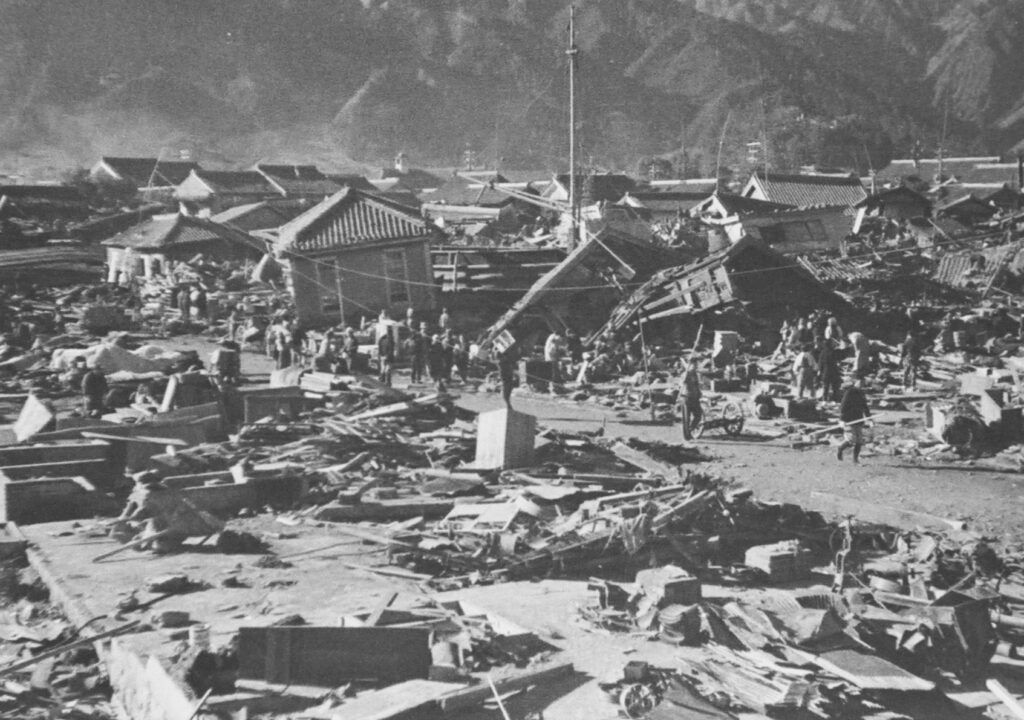
Impact & Significance
- Massive coastal flooding from tsunami waves
- Severe infrastructure loss in Shikoku and Honshu
- Accelerated research into subduction-zone earthquakes
Simple Seismic Relation
A commonly used approximation links seismic energy E to magnitude M:log10(E)≈1.5M+4.8
This illustrates why M8+ events release enormous energy capable of generating tsunamis.
- Nankai Trough: A subduction zone where the Philippine Sea Plate dives beneath Japan.
- Tsunami: Long-wavelength sea waves caused by sudden seafloor displacement.
- Subduction Earthquake: A quake occurring where one tectonic plate moves under another.